PRP Therapy in Sports: Why Athletes Choose Platelet-Rich Plasma
A pitcher walks off the mound in the fifth inning, and the trainer already knows what’s coming next. Tommy John is the guess everyone makes. The actual answer is often a syringe, not a scalpel. That gap between what fans assume and what’s happening in the training room is what this article is about. PRP injections have been part of pro sports since the mid-2000s, and they’ve drifted from the locker room into ordinary orthopedic offices. You don’t need a major league contract to ask about it. You need a ligament or tendon that hasn’t healed on its own schedule. Here’s how it actually works, who tends to benefit, and what to reasonably expect.
What platelet-rich plasma actually is
Your blood separates into parts. Red cells sink, plasma floats, and platelets ride along in that plasma layer. A centrifuge spins a small sample of your own blood and pulls out a concentrated dose of platelets, which is why the treatment is called platelet-rich rather than platelet-new. Nothing synthetic gets added. Nothing donor-derived gets injected.
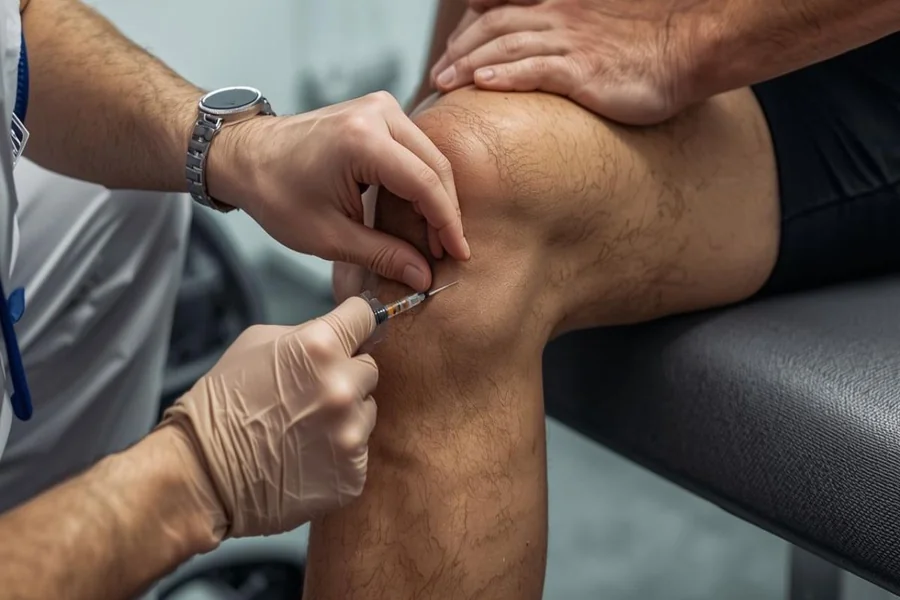
Those platelets carry growth factors, and the working theory is that a high concentration delivered straight into damaged tissue nudges the body’s repair process harder than it would go on its own. A doctor draws blood, spins it, and injects the concentrate into the problem area. Simple to describe. Getting consistently good outcomes, though, is where it gets interesting.
If you want the clinical vocabulary from a neutral source, the National Library of Medicine covers blood components in plain language. It’s worth ten minutes before any consult, because the questions you’ll ask get sharper once you understand what’s in the syringe.
Why it caught on with pro athletes
Timing drives everything in sports medicine. A procedure that saves a season beats one that costs six months even when the long-term data looks similar. That’s the whole reason PRP spread the way it did through baseball, tennis, and soccer.
I’d argue the cultural moment mattered as much as the science. Once a handful of high-profile names tried it, team doctors faced a new problem. Players started asking for it, and saying no required an explanation. That’s usually how a niche treatment becomes standard practice.
The recovery math that makes it attractive
For a partial tendon tear or stubborn tendinopathy, the alternative often means surgery and a long rehab runway. PRP usually means an injection, a few rough days, then progressive loading. The pitch is that you stay in your sport while the tissue catches up.
That’s a real advantage. It’s also where expectations go sideways, so it’s worth separating the categories.
- Acute sprains and partial tears in soft tissue
- Chronic tendinopathy that stalled after months of therapy
- Joint pain where surgery feels premature
- Bone or nerve problems, which aren’t the same conversation
Early or mild arthritis is its own situation. Some people get meaningful relief, some get a few quieter weeks. Nobody can promise which group you land in.
Meet the N=1 Rule
I made this one up after watching the same conversation play out too many times between athletes and clinicians. The N=1 Rule is simple: in regenerative medicine, you are your own sample size, and that sample size is one.
Population studies tell you what happened across hundreds of shoulders and knees. What they can’t tell you is what happens in yours. Your tear lives at a specific depth, in tissue with its own history. Maybe you’ve taken years of anti-inflammatories. Maybe you trained through it for a season when you should’ve rested. Those details don’t average out.
The practical version of the rule is this: judge PRP by what your own joint does across eight to twelve weeks, not by what happened to someone in a study or a highlight reel. Platelets have been shown to release growth factors, and basic science from the National Institutes of Health describes how that signaling works. Whether that signaling produces the outcome you want depends on factors no study can isolate for you.
The two-week gut check
You also need a cutoff point, decided in advance, for knowing when to move on. Pick it before the injection, not after. Two weeks in, one of three things is true: pain is clearly quieter and moving better, nothing has changed at all, or you feel worse and you’re limping more than before. Only the first deserves patience past the four-week mark.
A client of mine, a masters-level triathlete chasing a spring race, went through this exact sequence with an Achilles that had stalled for five months. She set her gut check on a Sunday morning before treatment, told her coach, and agreed to skip a block of speed work while she waited. At six weeks she was on a bike. At twelve she was running. That outcome wasn’t guaranteed. The decision structure was what she could actually control.
Reading the research without getting whiplash
You will find confident headlines in both directions. Some studies show real improvement in tendinopathy. Others show results that look a lot like placebo. Both things get published because the effects are often small and the study designs vary wildly, so authors disagree about what it all means.
The honest summary is that the evidence sits somewhere in the middle. It’s more settled for some tendon problems than others, and it tends to work better alongside rehab than as a standalone shot. If anyone tells you the debate is closed, ask what they’re selling. Review coverage from the British Journal of Sports Medicine gives you a sense of how careful researchers actually are when they talk about this stuff.
Questions worth asking before you schedule
Bring these to the consult, and write the answers down. You’ll want them later.
- How many injections, and how far apart?
- What counts as progress at week two, six, and twelve?
- What activity stays on the table right now, and what comes off it?
- What’s the plan if this doesn’t work?
Specific care matters here. A centrifuge protocol, a precise injection target under ultrasound, and a rehab plan that matches your sport aren’t nice extras. They’re most of the result. This is exactly where Rejuvenate Your Health PRP therapy in the Lehigh Valley fits for readers near eastern Pennsylvania, since the clinical part should be handled by someone who does it often and tracks outcomes.
Ask how many of these the clinician performs monthly. If the number is vague, that’s your answer. Cost runs a few hundred to well over a thousand out of pocket in most parts of the country because insurance rarely covers it, so get the total before the needle comes out.
Who shouldn’t bother
Skip it if you want a guaranteed fix. Skip it if you won’t do the rehab, because the injection alone rarely holds. Anyone on blood thinners, pregnant, or dealing with an active infection needs a different conversation entirely with a physician.
If you are a reasonable candidate, the logic is straightforward. It’s your own blood, a modest office visit, and a recovery window measured in weeks rather than months. The tradeoff is uncertainty, and you should decide up front whether a worthwhile chance is worth paying for. Read that tradeoff honestly, ask the two-week question, and let your own body be the final data point.