Clog or Collapsed Sewer? Reading the Clues in Older Philadelphia Homes
Slow drains and sudden backups are stressful and common in older Philadelphia homes with aging sewer laterals and stacks. Before you approve a costly excavation or accept another quick unclog, it helps to read the symptoms. Certain patterns point to a local blockage near one fixture, while others hint at trouble in the main sewer line that carries all wastewater to the street. By paying attention to which fixtures misbehave, where backups appear, and when noises or odors show up, you can decide the right next step: a targeted drain cleaning, a camera inspection, or a longer-term repair.
1. What Your Fixtures Are Telling You
If multiple fixtures on the same level start backing up at once, the main branch or the building’s main sewer line is the likely culprit. A classic example is a first-floor toilet that burps or gurgles when the washing machine drains, because the surge of water meets resistance in the main line and forces air through the toilet trap. Backups that appear at the lowest opening in the house, such as a basement floor drain or a laundry sink, are another strong sign the blockage is downstream of several fixtures. For regional context on common patterns and materials, see Philadelphia Plumbing Services.
By contrast, a single slow bathroom sink that clears when you remove hair from the pop-up or P-trap suggests a local clog in that fixture’s trap arm. A toilet that overflows while nearby sinks drain normally points to a stoppage in the closet bend or toilet itself. Two quick scenarios illustrate the difference: after a large gathering where wipes and paper towels got flushed, a toilet may clog without affecting the tub; after a heavy laundry day, a main blockage will push water up through a basement floor drain because it is the lowest relief point.
2. Likely Culprits in Aging Laterals and Stacks
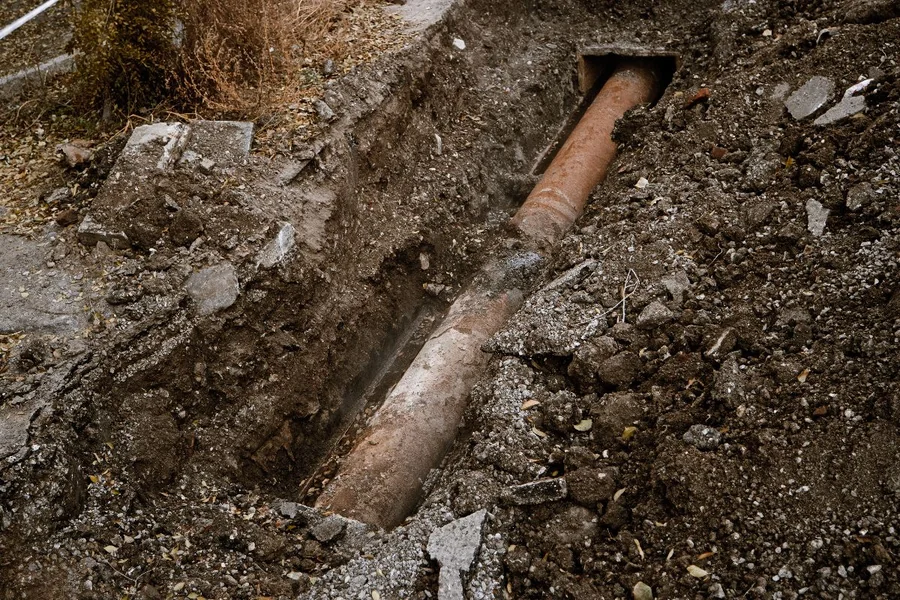
In older neighborhoods, tree-root intrusion through joints in clay laterals, heavy scale inside cast-iron pipe, and “bellies” where a pipe has sagged are frequent sources of chronic backups. Grease deposits are another common offender: over time, cooled fats narrow the pipe’s diameter and catch lint from laundry and food particles from kitchen drains. These conditions live downstream of your P-traps and branch lines, so clearing a sink trap will not solve them for long. If backups keep returning despite snaking, damage such as a separated joint or a partially collapsed section becomes more likely.
Weather and use patterns can add clues. If you occasionally notice sewer gas odor from a floor drain after a long dry spell, its trap may have evaporated and let odor through rather than signaling a blockage. If backups appear soon after rain, stormwater infiltration or soil movement may be stressing an old lateral, especially where clay or a legacy fiber pipe was used. A sudden, constant backup that does not respond to a standard auger can indicate a full collapse or a foreign object lodged in a tight turn of the main.
3. Safe Checks You Can Do Before Calling
Start by finding your main cleanout. It may be a capped fitting on the main stack, near the foundation wall, or in a yard box near the sidewalk. With a bucket and gloves ready, slowly loosen the cap. If water under pressure spills out, that confirms a downstream obstruction. If it is dry, run a tub and a sink for a minute, then flush a toilet. Watch the cleanout: if flow slows to a trickle and water rises, the main is restricted; if water zips by and your problem is only at one fixture, the issue is probably in that branch. Always reseal the cap snugly when done to keep sewer gases in the line.
Avoid chemical drain cleaners. Caustic products can heat and corrode older cast iron or galvanized pipe, and they complicate safe handling if a pro needs to cable the line. Instead, remove accessible traps to clear hair or debris, use a wet/dry vacuum on a sink overflow to pull a local clog, and check that roof vents are not blocked by leaves or a bird nest. A blocked vent stack can cause gurgling and slow drains because fixtures cannot pull enough air to move water smoothly through traps and horizontal runs.
4. Picking the Right Fix: Snaking, Jetting, and Lining
A professional evaluation often starts with a heavy-duty cable machine to cut through soft obstructions and minor roots, followed by a camera inspection to see the pipe wall. Snaking is good at punching a hole through blockages but may leave grease on the walls. Hydro jetting uses high-pressure water to scour grease and scale from the entire circumference of the pipe. That thorough cleaning can restore flow and improve camera footage. Trade-off: aggressive jetting on brittle clay or legacy fiber pipe can damage it if pressure isn’t carefully controlled. If a camera shows a “belly,” offset, or crushed section, the technician may mark the spot with a locator to map depth and path before recommending a repair.
When damage is isolated, trenchless lining or point repairs can rehabilitate the pipe with less digging. Cured-in-place pipe (CIPP) can bridge small gaps and smooth rough interiors. It does require a relatively clean, round host pipe and adequate access. A severe belly that holds water, a fully collapsed section, or a misaligned connection may rule out lining and favor excavation. For truly local issues, such as a recurrent clog in a kitchen branch, targeted solutions like descaling a cast-iron run, re-pitching a horizontal section, or replacing a sharp tee with a wye can resolve the cause without touching the entire main.
5. After the Backup: Preventing the Next One
Once flow is restored, prevention starts with habits and small upgrades. Keep fats, oils, and grease out of the kitchen sink. Use hair catchers in tubs and showers. Flush only toilet paper, and remind guests not to flush wipes even when labeled “flushable.” If your home has large trees near the curb, ask for a camera check every year or two to catch early root intrusion. Where local codes and site conditions allow, a backwater valve on the main can prevent sewage from reentering during a downstream surcharge. Adding an accessible cleanout, if you do not have one, makes future maintenance faster and cleaner.
Good diagnosis reduces surprises and unnecessary digging. Pay attention to which fixtures slow first, whether the lowest drain backs up, and how the system behaves during heavy use. Those clues help you choose between a focused drain cleaning, a camera inspection, or a measured repair, and they make any conversation with a plumber more productive. In older rowhouses and historic homes, reading the signs can be the difference between another short-lived clear-out and a fix that addresses the real cause.