
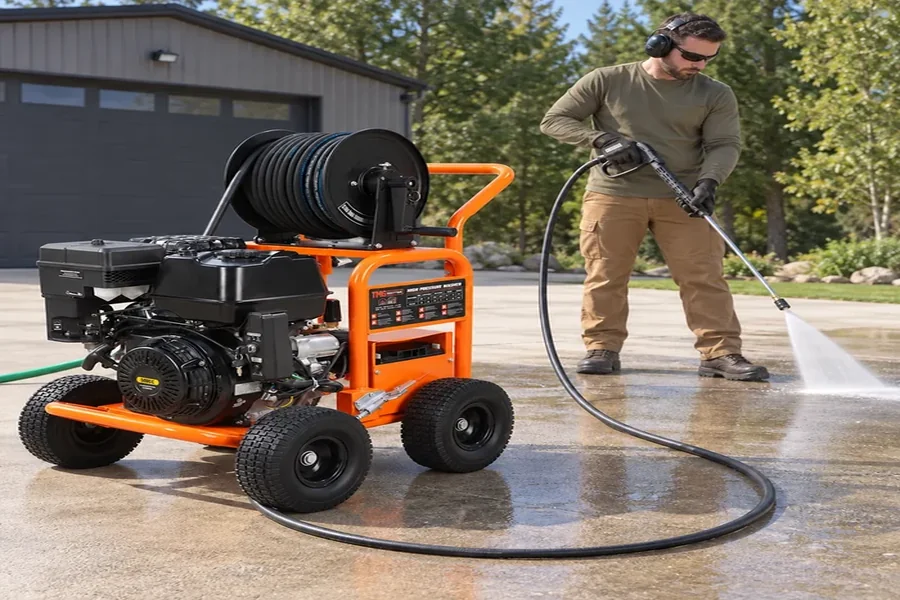
Why a Gas Pressure Washer Cleans by Pressure Times Flow
Why a Gas Pressure Washer Cleans by Pressure Times Flow
Pressure is the number on the box and the number buyers compare, which is why machines keep being sold on it. On its own it describes how hard the water arrives and says nothing about how much arrives. Both matter, and the product of the two is what actually removes material. A 4000 PSI gas pressure washer is only as useful as the flow rate underneath that figure.
What cleaning units describe
On a gas pressure washer, multiply pressure in pounds per square inch by flow in gallons per minute and the result is a rough measure of cleaning capability. Four thousand at four gallons is a substantially more productive machine than four thousand at two, even though the headline figures are identical.
The reason is coverage. Pressure breaks the bond between dirt and surface; flow carries the dirt away and widens the area being worked at any moment. A high pressure, low flow machine cuts a narrow stripe and takes a long time to cover a driveway.
Nozzle orifice sets the pressure for a given pump
This is the part that surprises people. A pump delivers a flow rate; the pressure that results depends on how small a hole that flow is being pushed through. Fit a larger nozzle and the pressure falls even though nothing about the pump has changed.
It follows that nozzles are matched to the machine rather than chosen freely. Too small an orifice produces pressure above what the pump should see and opens the unloader; too large and the machine never reaches its rating.
Spray angle trades force for coverage
A pressure washer nozzle is specified by angle, and the angle decides how the same energy is distributed. A zero degree tip concentrates everything into a point, which is the most destructive and the least useful setting on almost any surface.
Four angles cover nearly all work:
- Fifteen degrees for stripping and heavy soil
- Twenty five degrees for general cleaning
- Forty degrees for rinsing and soft surfaces
- A soap tip for low pressure application
The zero degree tip is included with most machines and it mostly belongs in the box. Almost anything it can do, a fifteen degree tip can do nearly as quickly and with far less risk of cutting a line into the surface underneath.
Too much pressure damages more than it cleans
Wood fibers lift, mortar washes out of brickwork, and vinyl siding takes water behind it. None of these are the machine failing; they are a tool applied at a setting the surface cannot take. Distance is the control nobody uses deliberately. Pressure at the surface falls rapidly as the nozzle is pulled back, so stepping away achieves what changing tips does, and it can be adjusted continuously while working.
Why gas rather than electric at this level
An electric machine is limited by what a domestic circuit supplies, and that puts a practical ceiling near two thousand pounds per square inch at modest flow, which is why a gas pressure washer dominates above that output. Beyond that the motor needs more power than a standard outlet provides.
A gasoline engine has no such limit, which is why every machine at four thousand pounds per square inch is engine driven. The trade is noise, exhaust and the maintenance any small engine needs, and it rules out indoor use entirely.
The pump is the component that decides lifespan
Axial pumps are compact, cheaper and typically rated for a few hundred hours. Triplex pumps run cooler, carry serviceable seals and valves, and last several times as long under the same duty. For occasional domestic use the difference rarely matters. For anything approaching daily work it is the specification that separates a machine that is still running in five years from one that is replaced in two.
Water supply is a limit people discover late
A gas pressure washer rated at four gallons per minute needs that much water arriving continuously, and the pressure washer gpm figure is what to plan the supply around. A garden tap on a long narrow hose often cannot supply it, and the pump then cavitates, which damages it quickly and quietly.
Checking the supply by timing how long a bucket takes to fill is a two minute test. It is worth doing before the first use rather than after the pump has been starved for a season.
Reading the specification as a pair
Pressure and flow are listed separately and have to be read together, because the product of the two is what the machine will actually do. Pump type, nozzle set and the required water supply describe whether it keeps doing it.
TMG Industrial builds this one as a gasoline machine rated at four thousand pounds per square inch. Checking the flow figure alongside the pressure, and confirming the water supply can keep up with it, is what turns a headline number into a working tool.