How to Choose the Right Utility Trailer for Your Texas Business
Most first-time trailer buyers get it backwards. They start with a budget, then a brand, and only then ask what the truck can actually pull. That order costs real money. I have watched guys buy a 7,000 pound trailer for a half-ton pickup, discover the loaded tongue weight squats the rear axle past legal, and end up back at the lot a month later trading in a nearly new unit at a loss.
Here is the good news. Matching a trailer to your work takes about twenty minutes of honest math, and it saves you from buying the wrong machine twice. This guide walks you through payload, deck choice, and the small details that separate a trailer you keep for a decade from one that fights you every Saturday morning.
Start With What Your Truck Can Legally Pull
Your truck’s advertised towing number is a marketing figure, not a legal one. The real ceiling is the gross combined weight rating, or GCWR, which is the total weight of the loaded truck plus the loaded trailer. You find it on the driver’s door jamb sticker, not in the brochure.
Pull the numbers and you will usually find the honest limit is lower than you expected. Curb weight, passengers, tools, and a full tank all eat into payload before the trailer even shows up. A crew cab half-ton with a bed full of gear often has less than 1,500 pounds of payload left, and a loaded trailer pushes 10 to 15 percent of its weight onto the hitch. Do that math before you fall in love with a deck size.
The federal government treats trailer safety as a shared responsibility, and the Federal Motor Carrier Safety Administration publishes the weight and equipment rules that apply once your combined rig crosses certain thresholds. Even if you never run commercially, those standards are a good sanity check on what a properly rated setup looks like.
Which Deck and Gate Setup Fits Your Actual Work?
This is where most buyers overspend or underspend, and it comes down to what you haul on a normal Tuesday.
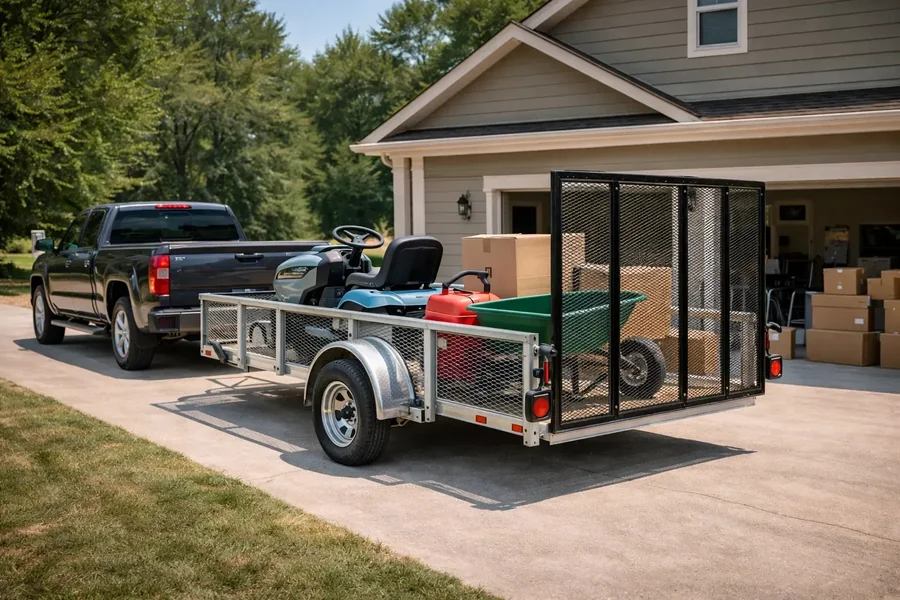
Open utility trailers with a wood or mesh deck handle landscaping gear, mowers, lumber, and general hauling. They are light, cheap to maintain, and easy to load by hand. If your work is mulch, sod, and a walk-behind mower, this is your trailer.
Pipe top and rail top designs add a perimeter rail that keeps loose material from sliding off and gives you tie-down points along the whole edge. Worth the small upcharge if you ever haul gravel or brush.
Landscape and enclosed units cost more but protect equipment from weather and theft. If your mowers live outside, an enclosed trailer pays for itself the first time someone walks off with a trimmer.
Dump trailers earn their keep the moment you stop shoveling. If you move more than a couple of yards of dirt or gravel a month, the hydraulic lift changes your day completely.
Ask yourself one blunt question: what did I haul most often in the last ninety days? Buy for that, rent for the outliers. Paying for a 20 foot deck to move a lawnmower twice a year is how trailers sit unused in a side yard.
Don’t Skip the Axle, Tire, and Ramp Details
Two trailers can share a deck size and price tag and still be wildly different machines. The difference lives in the parts you cannot see in a listing photo.
Axles decide your weight ceiling. A single 3,500 pound axle is a light-duty setup. Tandem 3,500s give you 7,000 pounds gross. Tandem 5,200s push toward 10,000. The GVWR sticker on the tongue is the number that matters, not the number the salesperson quotes from memory.
Tires fail more often than frames on Texas roads, especially in July when pavement temperatures climb and older rubber gives out. The National Highway Traffic Safety Administration keeps tire safety and recall information that is worth checking before any long haul with a loaded trailer.
Ramps and gates are the daily-use parts you actually touch. A spring-assisted gate saves your back. Fold-flat ramps store out of the way. Split gates let you load one machine at a time without wrestling a full-width panel. These small features are the difference between a trailer you like and one you tolerate.
Also look at the coupler and safety chains. A 2 inch coupler on a 7,000 pound trailer is standard. Anything bigger needs the matching ball, and mismatched hardware is one of the most common causes of a trailer coming loose. Check the chains, check the breakaway, check the lights before you sign.
A Quick Pre-Purchase Checklist
Run this list before you hand over a check. It takes ten minutes and it catches most of the expensive mistakes.
- Read the door jamb sticker on your truck and write down payload and GCWR.
- Estimate your heaviest realistic load, then add ten percent for margin.
- Match trailer GVWR to that load, not to your ego or your neighbor’s rig.
- Confirm the ball size, coupler class, and wiring connector match your truck.
- Test every light, both brakes if equipped, and the breakaway system.
- Inspect tire date codes, not just tread depth.
- Ask about service and parts availability near you before you buy.
That last item matters more than most people admit. A trailer that needs a bearing repack or a light replacement is a lawn ornament if you cannot get parts without a two hour drive. Buying from a dealer with a service department and stocked parts counter near your work route is worth a couple hundred dollars of sticker price every single time.
Used Versus New: Where the Real Value Sits
Used trailers are not automatically the smarter buy, and new ones are not automatically a waste. It depends on how the previous owner treated the unit.
A used trailer that lived on a farm and hauled hay has a very different wear profile from one that sat outside for eight years with flat tires and rusted wiring. Inspect the frame for cracks near the coupler and axle hangers, check the deck for soft spots, and look at the underside, not the shiny side up.
New trailers give you a warranty, current lighting standards, and parts that match today’s catalog. If you are running a business and downtime costs you money, that warranty has a real dollar value.
My honest take: if you can find a two or three year old unit from a dealer that services what it sells, buy used and save the depreciation. If you are buying private party with no service history, the savings usually evaporate the first time something breaks. A lot of North Texas buyers find that middle ground by comparing new and pre-owned inventory side by side, and it is the simplest way to shop trailers in the DFW area without driving to five different lots.
Match the Trailer to the Job, Not the Other Way Around
When you get this right, you stop thinking about the trailer. It just works. You hook up on a Saturday, load without drama, and the weight sits where it should on the road.
When you get it wrong, every trip reminds you. The gate is too heavy, the deck is too short, the lights flicker, and the truck strains on the grade. That is the version of ownership you want to avoid.
So do the math first. Write down your heaviest real load. Read the sticker on your truck. Pick the deck and axles that fit that number and nothing more. Then check the tires, the coupler, and the parts counter before you commit.
One question worth sitting with: if you tracked every load you hauled last quarter, what would your trailer actually need to be? Answer that honestly and the buying decision gets a lot smaller.