
Sd-wan Explained: What Happens to Data When It Moves Across a Modern WAN
A data packet may have traveled through multiple networks before arriving at the application in question, and the route that it travels through will not normally be apparent to the user who is using the application. A branch office worker might access a cloud-based application, engage in a video call, or use some corporate application while the network sorts out how to transport that traffic.
The most interesting aspect of SD-WAN technology is what occurs once the user sends out data. The network needs to determine the traffic, the paths that are available, apply its policies, transport the packets through the WAN, and react to changes in those conditions.
What Happens Before Data Leaves the Site?
Each route has to start somewhere, specifically within the local network. A client device generates traffic destined for a specific place, such as an application or corporate service hosted somewhere else. The local network sends this traffic toward the WAN edge device, which can then decide what to do with it next.
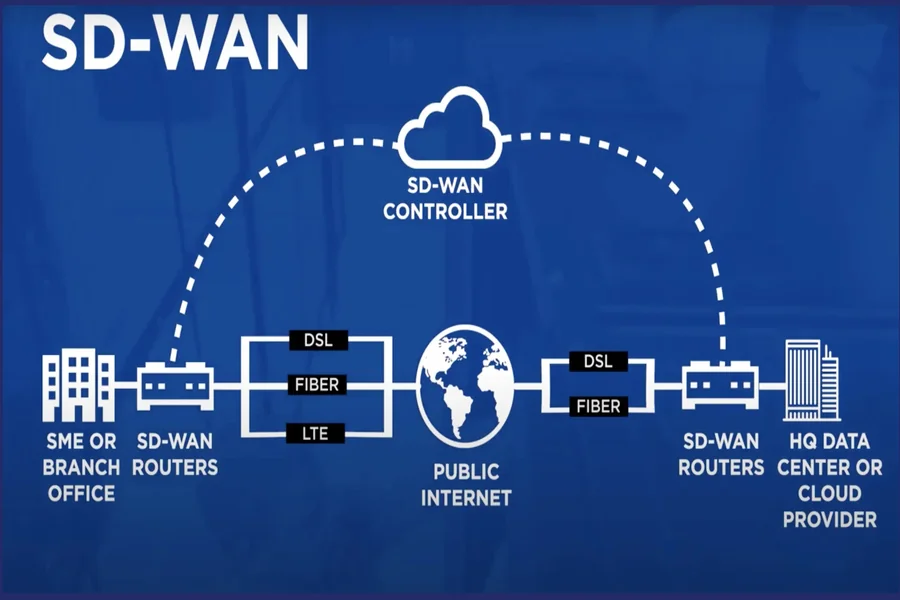
The site might be connected to the rest of the world through a dedicated line, broadband connection, cellular data link, or something else. In previous WAN architectures, static routing was common. But the SD-WAN paradigm allows this to be assessed. For a broader SD-WAN explained for beginners overview, the technology evaluates available connections and manages traffic across them.
The interconnections continue carrying the data. SD-WAN is not a new physical network but software-enabled control that manages traffic movement over the available WAN infrastructure. It can use multiple connectivity options and route applications according to defined policies.
How the Network Decides Where Data Goes
When traffic arrives at the WAN edge, the network will be able to make decisions about how to handle it by comparing the traffic requirements against the available routes. Some of the factors involved could be application requirements, latency, packet loss, jitter, available bandwidth, link availability, security requirements, and business requirements.
Take for example a branch office with two WAN connections. Voice traffic may need low latency and low packet loss, while backup traffic may allow high latency.
This is one of the main concepts of SD-WAN technology: the path choice may depend on the traffic requirements, rather than being based solely on a fixed route. Application-aware routing and dynamic path selection are typical features of SD-WAN technologies.
The journey of traffic may consist of the following steps:
- A user begins the application session.
- WAN edge recognizes the traffic and applies policies to it.
- Possible links are assessed in terms of the existing situation.
- The chosen path routes the traffic to its destination.
- The network constantly assesses the performance and changes the path if necessary.
What Happens Across the WAN?
Once a route is chosen, traffic travels over one or multiple WAN links. In many configurations, an overlay network is formed over the lower-level transports. An overlay creates a logical layer over which networking takes place and which may exist over different physical or service provider links.
Encapsulation may also be involved. Traffic may be encapsulated into an encrypted or otherwise managed tunnel before being carried over the transport network.
This separation of logical networking from physical connectivity enables companies to employ diverse WAN transports without having to design their network based on any one connection.
What Happens When Network Conditions Change?
The conditions of the WAN are seldom constant. There could be congestion on the link, increased latency, packet loss, or failure of the connection. The static routing solution will require manual action or traditional failover solutions to handle this problem.
In an SD-WAN world, there is monitoring of the link and comparison with the established policies. In case the link fails to fulfill the needs of the application, the traffic can be rerouted to a different path, provided that the infrastructure supports it.
Imagine a branch using one connection for a real-time meeting and another for general traffic. If the first connection develops significant packet loss, the network can recognize that it no longer meets the application’s requirements and steer eligible traffic through another suitable path.
Centralized Control Changes Network Operations
This is yet another phase that takes place outside the data plane. With SD-WAN deployments today, the common practice is to manage the process in a centralized manner through policy definition, site monitoring, and coordination of configurations.
As such, administrators are not required to configure every branch router as an independent unit. Policy definition will take place in a centralized manner for multiple locations.
Architecture is dual-folded; one side is a data plane that carries out traffic, while another side is management and control functions that define the behavior of the network. It all goes together with the general concept of Software Defined Networking, which means network behavior may be managed by software.
How Different Traffic Types Move Across the WAN
Different applications have different network requirements, so SD-WAN policies can account for the type of traffic being transported.
| Traffic Type | Key Requirement | Path Consideration |
| Voice calls | Low latency and jitter | Favor stable, consistent paths |
| Video meetings | Reliable bandwidth and low latency | Consider current link performance |
| Cloud applications | Availability and consistent performance | Select paths based on policy |
| File transfers | Bandwidth and reliability | Use available network capacity |
| Backups | High throughput, less latency-sensitive | May use secondary connections |
| Web browsing | General availability | Use suitable available paths |
This approach allows the network to handle traffic according to application needs rather than applying identical rules to every flow.
Why the Data Journey Matters
Knowing the journey is more valuable than knowing the specific features of SD-WAN by heart because the technology is fundamentally meant to adapt WAN traffic to the needs of applications.
It becomes significant for enterprises which deploy applications across data centers, private cloud facilities, public cloud providers, and Internet-based services because traffic no longer travels a single path from branches to the hub but may have various endpoints, performance constraints, and security policies.
Independent technical standards work also reflects the growing complexity of software-defined WAN services. Recent specifications address SD-WAN information flows, dynamic path control, service monitoring, and coordination between network domains.
The complexity associated with software-defined WAN services is also captured by the independent standards development work. The recent standards cover such areas as SD-WAN information flow, dynamic path control, service monitoring, and domain collaboration.
For further technical context, the IEEE guide to software-defined networking provides an overview of the network separation concept. The IETF SD-WAN edge discovery specification provides technical context on how SD-WAN can leverage multiple connectivity services and select tunnels based on performance, policy, and service requirements.
Frequently Asked Questions
1. Does SD-WAN replace the physical WAN connection?
No. The SD-WAN works on top of existing connectivity such as broadband, private circuits, or even cellular connections. It manages the network software-wise without eliminating the transport itself.
2. Is every application using the same WAN path?
It does not always have to be. The SD-WAN policy can segment and define path requirements for each specific type of traffic or application.
3. Can SD-WAN respond to a failed WAN link?
Certainly, some of the SD-WAN models provide failover and path selection capabilities. In case of unavailability of the connection or failure to satisfy specified performance criteria, traffic may be routed through alternate links.
4. Is SD-WAN only useful for large enterprises?
Not necessarily. The idea is applicable even to companies with dispersed locations of varying sizes. What works will depend on the number of sites, available network connections, application needs, security considerations, and available resources.