The Future of Visual Storytelling: How Conversational AI is Transforming Video Editing
Video has unequivocally cemented itself as the cornerstone of the modern digital experience. From short-form social media reels and comprehensive marketing campaigns to long-form educational tutorials, visual storytelling captures audience attention far more effectively than static text or images. However, behind every seamless, engaging video lies a notoriously complex and time-consuming post-production process.
Historically, video editing required a high degree of technical expertise, expensive hardware, and hours of meticulous labor. Editors had to sift through gigabytes of raw footage, manually cut out dead air, synchronize multiple audio tracks, and build transitions frame by frame.
For independent creators, small business owners, and busy marketing teams, this steep learning curve and heavy time commitment often served as a massive operational bottleneck, preventing them from scaling their content to meet modern audience demands.
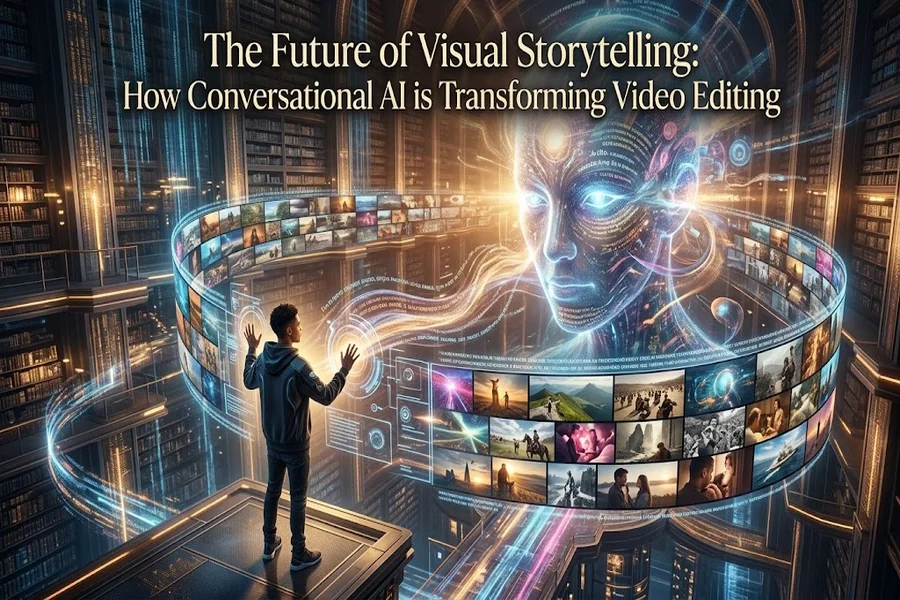
Today, the integration of Artificial Intelligence (AI) and Large Language Models (LLMs) into the editing suite is shifting this paradigm. By replacing complex, multi-track timelines with conversational prompts, creators can now assemble, refine, and polish their visual stories in a fraction of the time.
The Evolution: From Non-Linear to Conversational Editing
To understand the magnitude of this shift, it helps to look at how editing has evolved. The industry transitioned decades ago from physical tape splicing to Non-Linear Editing (NLE) software, which digitized the timeline and allowed editors to move clips around freely. While revolutionary at the time, NLEs still required the user to act as a highly technical operator, memorizing keyboard shortcuts and manually executing every single creative decision.
The current technological leap is moving the industry from manual manipulation to conversational editing. Instead of interacting solely with razor tools and nested sequences, modern creators can communicate with their editing software just as they would with a human assistant. By utilizing natural language processing, you can simply type out your instructions.
You specify the mood you are aiming for, the specific moments to prioritize in your raw footage, and the overall pacing required for your project. The AI analyzes the media, interprets your text, and automatically structures a baseline narrative.
The Mechanics of Text-Based Workflows
The true breakthrough in this space is the seamless integration between powerful text-based chatbots and professional video rendering engines. We are now seeing specialized platforms that bridge the gap between text-based brainstorming and actual timeline generation.
For instance, utilizing a ChatGPT video editor allows creators to leverage familiar conversational AI to seamlessly transition from generating a conceptual script to assembling the corresponding media. The workflow is incredibly intuitive. A user can write a prompt such as, “Draft a 60-second script about the benefits of remote work, and generate a video rough cut using modern office stock footage with an upbeat background track.”
The AI processes the request, structures the narrative, sources relevant visual assets, and arranges them into an editable timeline. You are no longer staring at a blank screen wondering where to begin; you are immediately provided with a highly structured first draft, directed entirely by your natural language instructions.
Key AI Capabilities Enhancing Post-Production
Beyond simply generating initial drafts, advanced AI editing workflows feature intelligent capabilities that streamline the most tedious aspects of the polishing process:
- Context-Aware Asset Matching: The AI actively analyzes the context of your written script and automatically matches it with suitable design templates, B-roll footage, and visual effects. If the script is energetic, it applies fast cuts and bold fonts; if it is corporate and educational, it suggests clean, professional lower-thirds.
- Automated Dead-Air Removal: Dealing with raw audio is often frustrating. AI algorithms can instantly detect and remove awkward pauses, throat clears, and filler words, tightening the overall pacing so the dialogue flows naturally without sounding robotic.
- Intelligent Subtitling: In a mobile-first digital landscape, a massive portion of video is consumed with the sound muted. AI video editors feature powerful speech-to-text engines that generate perfectly synchronized, stylized subtitles almost instantly. Many tools also offer real-time translation, allowing you to adapt your video for a global audience effortlessly.
- Smart Auto-Reframing: Content created for a widescreen format (16:9) rarely performs well on vertical-first platforms like TikTok or Instagram Reels. AI can automatically track the primary subject in a video and intelligently crop the frame to fit different aspect ratios, allowing creators to repurpose one video across multiple platforms instantly.
Preserving the Human Element in Automation
A common anxiety surrounding AI-assisted video editing is the fear that it will force creators to accept rigid, machine-generated final products, thereby removing the human touch and emotional nuance from the artistic process.
In reality, the most effective AI video tools are designed to serve as collaborative creative assistants, not autonomous replacements for human ingenuity. When an AI generates a rough cut or applies a visual template based on your conversational prompt, the resulting timeline remains fully unlocked and editable.
You are never locked into the algorithm’s initial structural decisions. Once the baseline edit is placed on the timeline, you have complete freedom to manually trim clips, adjust audio levels, swap out transitions, and apply custom color grading. The AI handles the repetitive, structural phases of production, giving you more time, energy, and creative bandwidth to focus on refining the narrative, tone, and final artistic polish.
Frequently Asked Questions (FAQs)
What exactly is a prompt-based AI video editor?
A prompt-based AI video editor is a software platform that utilizes natural language processing to assist in video creation. By typing conversational instructions, the AI analyzes your text and automatically writes scripts, sources media, and arranges footage into an editable rough cut directly on a video timeline.
Does conversational AI generate video entirely from scratch, or can I use my own footage?
It depends on the specific workflow. While some generative AI models create synthetic video pixels from scratch based on text, professional AI editing workflows allow you to upload your own raw video and audio files. The AI acts as an assistant to organize, cut, and structure the authentic media you provide.
Do I need a powerful computer to run AI editing software?
Not necessarily. Most advanced AI video editors operate entirely in the cloud through your web browser. The heavy computational processing required to analyze footage, generate subtitles, and render effects happens on remote servers, meaning you can edit high-quality video on a standard laptop.
How does AI handle audio synchronization and subtitles?
AI editors feature built-in neural speech-to-text engines that automatically transcribe spoken dialogue with remarkable accuracy. The software then synchronizes the text with the exact timing of the speaker’s voice, generating on-screen subtitles that you can easily format, stylize, or translate.
Will the AI lock my timeline, preventing manual adjustments?
No, you retain absolute creative control. The AI’s output is intended to serve as a foundational first draft. Once the initial timeline is generated, the workspace remains fully unlocked, allowing you to manually swap clips, adjust micro-transitions, rewrite captions, and refine audio levels before exporting the final file.
Conclusion
The technical barriers to high-quality video production are dissolving at an unprecedented rate. By embracing conversational AI and intelligent timeline automation, anyone from a solo digital creator to a global marketing team can bypass the most frustrating, time-intensive aspects of post-production.
Whether it is translating a simple text prompt into an instant rough cut, automatically matching footage to stylized templates, or generating globally accessible subtitles, AI acts as a tireless digital assistant. It dramatically scales your creative output while ensuring you retain ultimate control over your story. The future of digital content creation belongs to those who learn to collaborate effectively with these emerging technologies, merging human creativity with incredible machine efficiency to tell better, more engaging stories.