5 Things to Check Before Buying a Luxury Apartment in Dubai

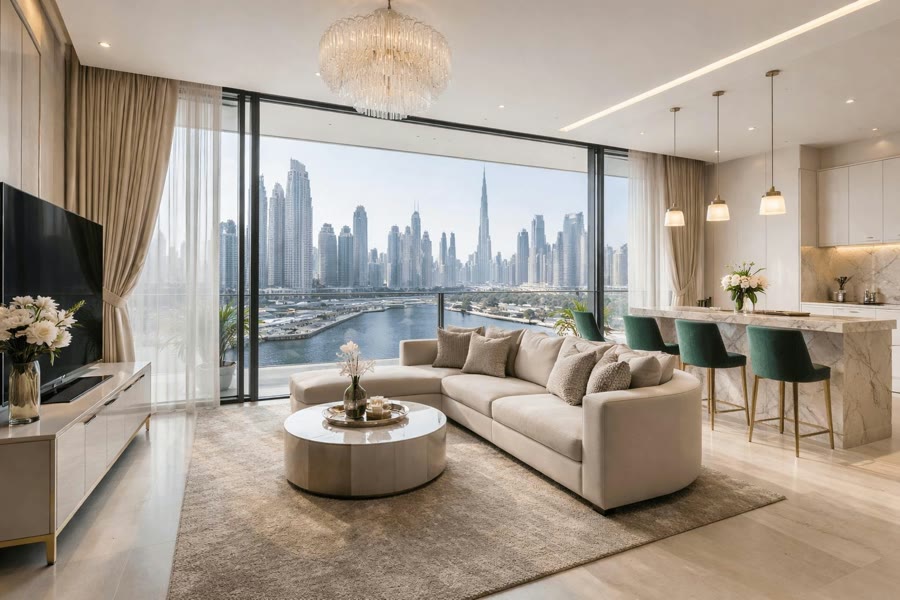
Picture a buyer, call her Sarah, flying in from London for a long weekend. By Saturday afternoon she’s standing on a balcony forty-something floors up, the sea’s gone silver, and the sales manager mentions, very casually, that only two units are left at this price. Sarah had a spreadsheet. Right now she can’t remember where she saved it.
Most first-time buyers have a Sarah moment. And honestly, it’s easy to see why so many people want to buy property in Dubai: the city logged 80,509 residential sales worth AED 226.5 billion in just the first half of 2026. But fast markets have a way of rushing people. So if you’ve been looking at Luxury Apartments for Sale in Dubai and you’re getting that itch, here are five things to check first. None of them are glamorous. All of them matter.
1. Where Is It, Really?
Not “Dubai.” Which building, which street, what’s next door.
People fall for the apartment, but they end up living with the neighbourhood. Two units can have the same marble and the same view and still turn out completely differently. One is in a community where tenants are waiting in line. The other faces a construction site that’ll be noisy until 2029.
Which of the best places to buy property in Dubai suits you depends on what you want out of it. For a waterfront address with bragging rights, Palm Jumeirah was still the top ultra-luxury apartment area in H1 2026, and Dubai Marina led the luxury segment. Moving out with kids? Then schools and parks probably beat sea views, and people in that spot often end up looking at Dubai Hills or Sobha Hartland.
Go back on your own, without the agent. Try a Tuesday at 8 a.m., when the traffic’s at its worst, and again on a Friday night. Get a coffee downstairs and just watch for a bit. You’ll learn more in twenty minutes than from any brochure.
2. Who’s Building It, and Have They Done This Before?
Plenty of luxury properties in Dubai are sold off-plan, which is a polite way of saying the building doesn’t exist yet. The payment plans can be genuinely good. But what you’re buying is somebody’s promise, so it’s worth asking whose.
Look at what they’ve actually finished. Was it on time? Does it look like the glossy renders, or did the “imported stone” quietly become something else? If they’ve got a completed tower in the area, go and walk through it. Even better, find a resident by the pool and ask how it’s been. People are usually happy to tell you.
The good news is that Dubai has proper safeguards. When you buy an off plan property in Dubai, your money’s meant to go into a regulated escrow account tied to that specific project, not the developer’s day-to-day account. The project should be registered with RERA, and your purchase logged with the Dubai Land Department through Oqood. If anyone tells you to transfer to a personal account, or that registration can “happen later,” that’s your cue to leave.
3. What Will It Actually Cost You?
The listing price is where the maths starts, not where it ends.
Dubai property prices come with extras. The Dubai Land Department charges 4% to transfer the property, plus registration and trustee fees. Agency commission usually runs around 2%. A mortgage adds its own arrangement and valuation fees, and if you don’t live in the UAE, banks will generally lend you less than they’d lend a resident.
Put real numbers on it. On a AED 3 million flat, the DLD fee alone is AED 120,000. That’s a car, give or take.
And then there are service charges, which nobody mentions on the balcony. The infinity pool, the concierge, the beautifully lit lobby: owners pay for all of it every year, by the square foot. Ask what the building charges now and what it charged three years ago. A cheaper unit with steep service charges can easily end up costing more than the pricier one next door.
4. Will It Earn What You Think It Will?
Here’s the part that surprises nearly everyone. Luxury apartments often earn less rental yield than mid-range ones. They rent fine. They just cost a lot more to buy, so the percentage comes out smaller.
The August 2026 figures show it clearly: roughly 4.66% on Palm Jumeirah, 5.21% in Downtown, 5.64% in Dubai Marina. Some affordable areas, International City for one, were getting close to 9%. For comparison, the citywide average gross yield was 6.6% in June 2026.
So is luxury a poor Dubai real estate investment? Not at all. It just pays you in a different way. Prime buyers are usually after long-term growth, a safe place to park wealth, and somewhere they’d genuinely like to live, more than a fat monthly rent cheque. Prime areas also tend to attract tenants who stay for years and actually look after the place.
Residency is a real part of the decision too. Spend AED 2 million or more and you may qualify for the UAE Golden Visa. For a lot of overseas buyers, that’s half the reason they’re here.
One more thing: yields you see online are almost always gross. Knock off service charges, maintenance, a month or two empty between tenants, and management fees. The number left over is the one to plan around.
5. Is Everyone Who They Say They Are?
Dubai’s property system is pretty transparent, as long as you actually use it.
Buying a ready apartment? Check the title deed through official DLD channels, such as the Dubai REST app, and make sure the seller is the person on that deed. Before transfer, the developer has to issue a No Objection Certificate confirming that service charges are paid. If there’s already a tenant, ask for the Ejari registration and read the lease properly, since it comes with the flat.
Check the agent as well. Licensed brokers have a RERA Broker Registration Number, and every real property ad in Dubai carries a Trakheesi permit number. A decent real estate agency in Dubai will show you both without blinking. If you get waffle instead, move on.
So, Back to Sarah
Did she buy it? Maybe. Maybe a different unit, in a different building, a month later, after checking the service charges and finding out the “last two units” weren’t really the last two.
That’s honestly the whole point. Hardly anyone regrets taking an extra week. Plenty regret the deposit they paid on a Saturday afternoon. For another look at deadlines, see the first 10 days after your offer is accepted.
If you’d like someone experienced, and licensed by the DLD, looking over your shoulder, Professor Property works with first-time buyers and overseas investors from the first viewing right through to handing over the keys. Visit Professor Property and book a consultation. Bring your spreadsheet if you can find it.